

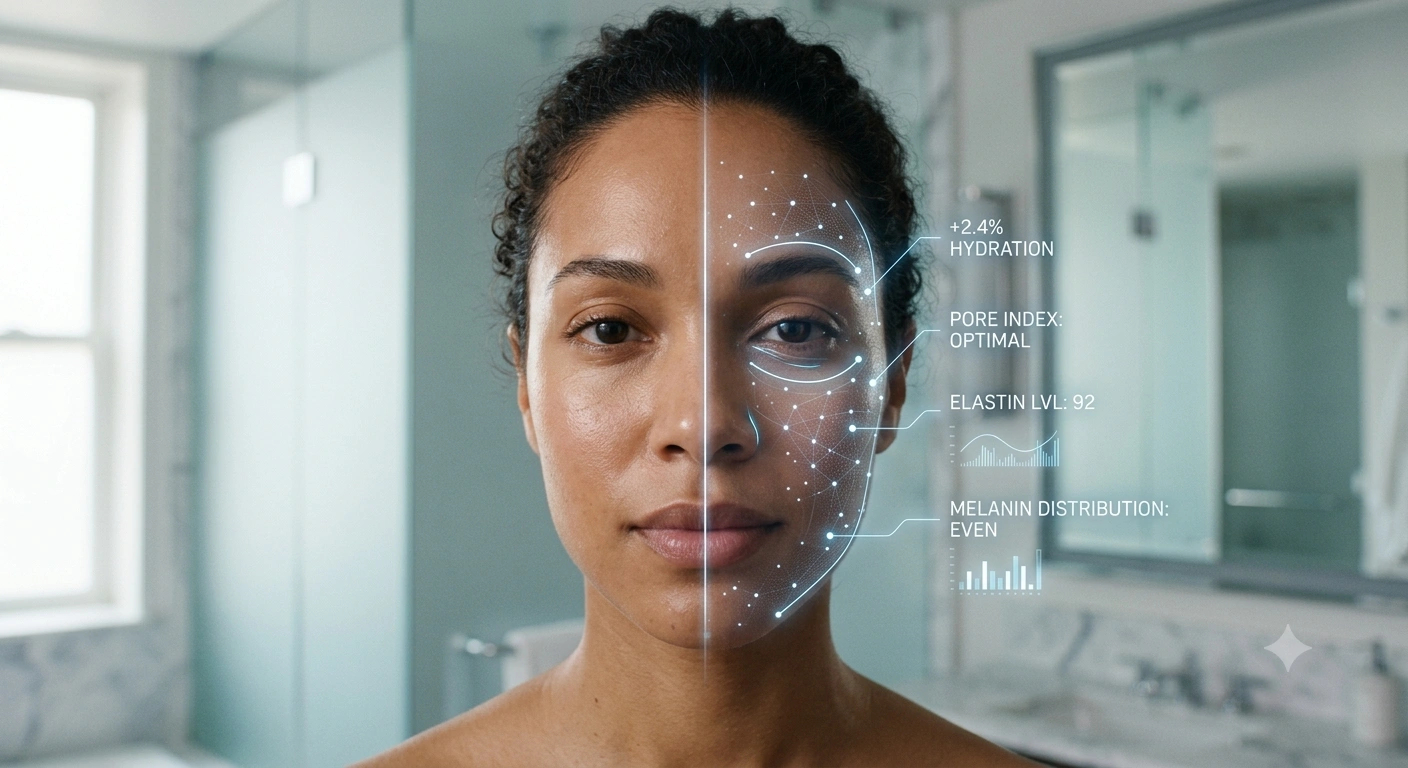
Skincare tips ai technology :You scan a barcode or snap a selfie, and within two seconds. An app tells you exactly which moisturizer won’t clog your pores. No more wandering aisles.
That’s the promise of AI skincare technology. For plenty of of us who have tried everything from drugstore staples to luxury prescriptions, the real question is whether these apps deliver or just add (which aligns with standard practices) another layer of anxiety.
TL; DR
- AI skin scanners assess up to 14 traits like redness, pores, and oil levels in under 2 seconds, often matching clinical assessments with 90-95% accuracy.
- Personalized engines cross-reference your local weather, pollution data, and over 4,000 scientific studies to recommend ingredients suited to your unique skin type.
- Smart mirrors and tracking tools build a digital diary of your skin’s progress, and biometric privacy concerns remain a significant hurdle.
Key Point
- AI analysis catches early sun damage invisible to the naked eye, potentially preventing hyperpigmentation years later.
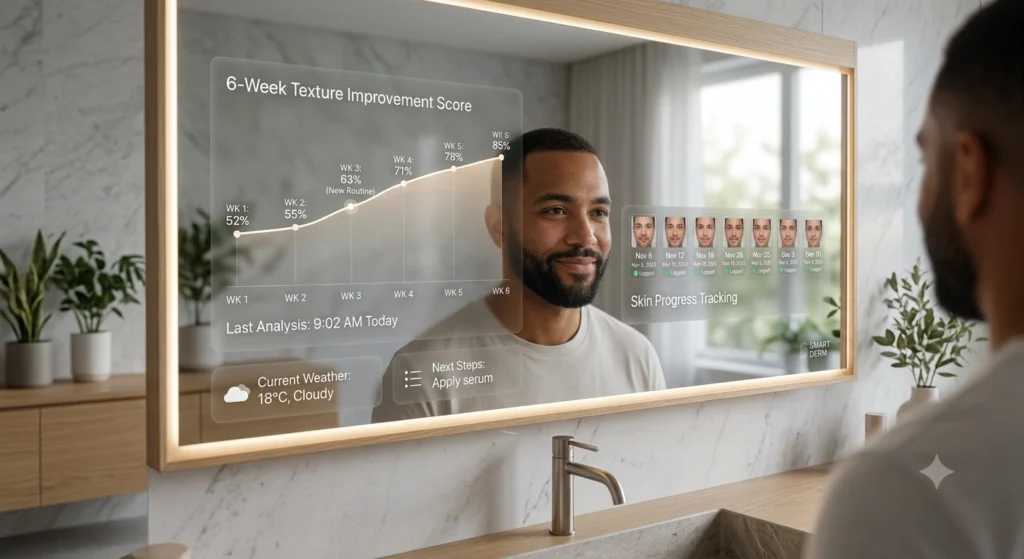
- Daily tracking on a smart mirror reveals whether that $80 serum actually improves texture over 8 weeks — something manual observation often misses.
- The single biggest mistake: treating an app’s “skin age” score as a hard fact instead of a rough benchmark, especially in poor lighting.
- Overreliance on automated suggestions can lead to skin dysmorphia when every tiny flaw gets highlighted each morning.
What Is AI-Powered Skin Analysis?
AI skin analysis relies on computer vision. Deep learning to weigh facial features from a photo or live video.
The system breaks down visible data points; pore size, wrinkle depth, redness distribution, moisture levels, and even sub-surface pigmentation. Compares them against massive training datasets.
The goal isn’t just a cosmetic count but a reproducible baseline that dermatologists like Dr. 0 seconds per scan, according to recent consumer tech reports.
That speed isn’t just for show. It enables real-time recommendations. For the most part, it is the kind of instant feedback loop that used to require a dermatoscope and a trained professional.
💡 Pro Tip
Take your daily scan in the same spot with the same lighting each time — near a window with indirect natural light gives the most consistent results.
How does AI actually “see” my skin?
This reflects what I mentioned a while ago, it’s not magic. It’s pattern matching. The camera captures pixels, and a convolutional neural network — thinking about it more, trained on millions of labeled skin images pinpoints features.
Wrinkles, sebum levels, dark spots. The app then synthesizes this into a score or a list of concerns. Because the system relies on your phone’s camera, results can shift dramatically with lighting changes. In many cases, what this means is which is why many anyone on the platform on forums like Reddit report that their “skin age” jumps by 10 years between two scans taken minutes apart in different rooms.
This inconsistency isn’t a failure of the technology per se. Now, it’s a reminder that the input quality drives the output.
⚠️ Warning
If you scan near a window on a cloudy day vs. a sunny one, your results can look like two entirely different skin types. Always control your light source.
How Personalization Engines Go Deeper Than a Quiz
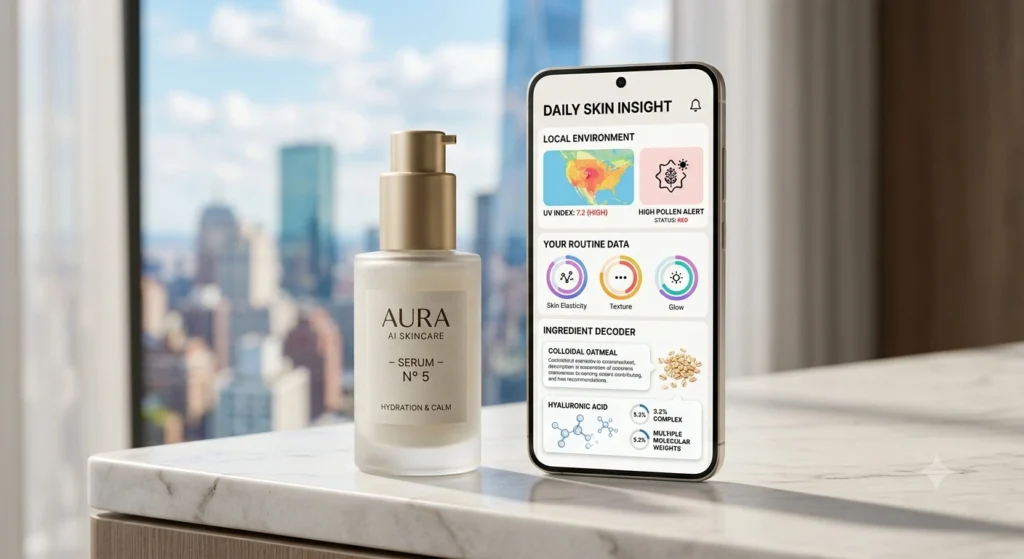
Dropping a long questionnaire into an email signup flow isn’t personalization. True AI-powered personalization, the kind that starts to approach what Ming Zhao describes as “not a product, it’s a personalized algorithm,” pulls from multiple live data streams. It clicks once you see it in action. Nine times out of ten, then the system cross-references over 4,000 scientific papers to match ingredients.
Not just to your stated preferences, but to your DNA-level predispositions when genetic data is offered.
If you think about it, when I first connected an AI skin app to, hmm, let me put it differently, (depending entirely on the context) my local weather station. I was genuinely surprised.
The app flagged that the pollen count that day was high and suggested a barrier cream with colloidal oatmeal; an ingredient I’d rarely ever have thought of because my skin didn’t feel reactive yet. And it worked.
It’s not just reacting to what your face looks like; it’s anticipating what it’ll need in six hours.
What’s the real difference between a quiz and an AI routine builder?
In the mirror, a static quiz asks you to self-assess your pores. And redness, notoriously unreliable due to the fact that we all have blind spots.
An AI routine builder iterates. It watches your skin change over time and adapts. If your texture score improves after switching to a glycolic acid toner, it recommends staying the course.
If moisture levels plummet, it pulls back on exfoliants. It is the difference between a one-time GPS destination and a navigation app that reroutes you around traffic. The constant recalibration is what makes the advice stick.
“AI provides a baseline for tracking progress that manual observation often misses.” — Dr. Corey L. Hartman
The Real Benefits That Go Beyond Hype
You’ll want to pay attention here. Beyond the buzzwords, concrete advantages exist that tackle actual frustration.
About 73% of beauty buyers feel overwhelmed by the sheer number of pieces available. Read that again if you need to. And AI acts as a filter. It cuts through marketing noise by matching your specific lipid barrier data.
The key here is that erythema levels, or melanin distribution to ingredients shown to help in clinical literature. No more Instagram hype cycles.
Another underdiscussed win, early detection. AI tools can highlight areas of sun damage that are invisible to your eye but show up under the camera’s spectral analysis.
This lets you target those areas with antioxidants and SPF before they become visible hyperpigmentation. I’ve seen scans of most of us in their late 20s who had no idea they were accumulating subclinical sun damage until the app flagged a (which aligns with standard practices) high periorbital damage score.
That is practical information. Of course, actual metrics may shift.
Then there is the cost argument. But a dermatologist consultation might run $150-$300, and while nothing replaces a medical professional for serious conditions, an AI scan gives you a free, instant baseline for your daily routine. Let that sink in for a second. It connects complete guesswork and a professional exam.
For tracking whether a product works. It replaces the fuzzy “I think my skin looks better” with a hardness score on texture that you can watch trend up or down over weeks.
📌 Key Point
The 90-95% accuracy vs. clinical assessments holds best in controlled, well-lit conditions — in a dark bedroom, expect that number to drop significantly.
The Hidden Risks Nobody Talks About
Here’s the part that makes me pause. When an app a lot points out small “flaws,” the cumulative psychological effect isn’t trivial. Skin dysmorphia is a real risk. I’ve watched a friend obsess over a 4% increase in her nasolabial fold depth score in a — actually, hold on, week, convinced she needed fillers, when in (depending entirely on the context) reality she was just dehydrated.
The data speaks for itself. The app didn’t cause that.
But the constant quantified feedback can boost existing anxieties.
Privacy is another elephant in the room, your biometric facial data, the exact geometry of your face, pore patterns, pigmentation distribution, is being stored on servers. Regulations are patchy. The question of who owns that data and how it’s monetized is far from resolved. When you scan your face, you’re handing over an incredibly sensitive asset.
One that can’t be reset like a password.
There’s also a commercial bias baked into quite a few apps. If the brand that makes the scanner also sells a line of serums. Its algorithm may naturally steer you toward its own products, particularly the expensive ones. Reddit users a lot complain that certain apps love to recommend a $65 vitamin C serum from the parent brand over a generic one that’s the identical active ingredient profile.
Make of that what you will. The technology is neutral; the business model rarely is.
Can AI skin apps actually make my skin worse?
Still, yes, if you over-exfoliate because the, actually, that’s not quite right, app tells you your texture demands work. And you chase a perfect score. Real skin asks for recovery time. Also, if you slather on 10 different actives based on algorithmic suggestions without understanding how ingredients interact, you risk barrier damage.
The app sees isolated concerns; you go through the cocktail.
How to Use Skincare Tips AI Technology Without Losing Your Mind
Now, putting aside the extremes. Using these tools smartly is about boundaries. They should inform, not command.
- Establish a consistent scanning protocol. Same time of day, same room, same light direction. This removes the biggest variable — lighting — and makes trendlines meaningful.
- Use the analysis to pick one or two primary concerns. Do not try to address redness, pores, wrinkles, and dark circles all at once. Let the data highlight the top issue.
- Cross-check recommendations with independent ingredient databases. If an app suggests a product, verify that the star ingredient appears in the first five items of the ingredient list and that it has peer-reviewed backing for your concern.
- Track progress weekly, not daily. Daily fluctuations are noise. Look for the 6-week trajectory.
- Always listen to how your skin feels. If a product burns, do not keep using it because the app gave a high suitability score.
“The future of skincare is not a product, it is a personalized algorithm.”
✅ Action Steps
- Choose an app with peer-reviewed validation. Look for studies published in journals like the Journal of the American Academy of Dermatology that vouch for its accuracy.
- Scan at the same hour daily. Mid-morning, after cleansing but before applying products, works best for many people.
- Ignore the “skin age” number. It is a marketing gimmick with high variability. Focus instead on the specific trait scores.
- Pair the app with a physical diary. Note any tingling, flushing, or breakouts the app cannot see. Combine data streams.
- Reassess your privacy settings. Check if the app sells anonymised data and opt out wherever possible.
People Also Ask
Do AI skincare apps work on all skin tones?
Most leading AI systems are trained on diverse Fitzpatrick skin types. But some older models underperform on darker skin tones. A different perspective.
Industry data from dermatology conferences suggests newer neural networks trained on broader datasets now achieve around 90% accuracy (and rightly so) across all tones. Worth pausing on that one. When lighting is consistent.
Are free AI skin scanners as good as paid ones?
Free versions regularly use basic image processing, not deep learning, and lack the longitudinal tracking that makes AI genuinely useful. Paid tiers usually offer trend analysis. Weather integration, and ingredient matching. But free versions can still identify major concerns like dehydration or uneven texture.
Can an AI skin app replace a dermatologist?
No. AI apps are screening apps, not diagnostic devices. They can’t detect melanoma, eczema; or infections. If you’ve a mole that changes shape, you need a board-certified dermatologist, not a smartphone camera.
How often should I scan my face with an AI tool?
Once daily Meanwhile, is more than enough. More frequent scans add noise. Weekly or biweekly scans work better for long-term progress tracking because skin turnover cycles are about 28 days, so daily changes are constantly meaningless.
What is the biggest limitation of AI skincare technology?
So, in plain English: blocksep matters. Lighting variability; even the most advanced algorithm can’t totally compensate for a dimly lit room versus a bright overcast window. This single factor can swing your pore score by 30%. Or more between scans, causing unnecessary alarm.
Conclusion
Skincare tips AI technology is not a; to be more precise, gimmick, but it’s not a magic wand either. When used with consistent lighting and a healthy dose of skepticism about brand-led recommendations. Arguably it helps you catch early sun damage, avoid ingredients that trigger reactions.
Actually see whether that $50 serum does anything over two months. The risk comes when you hand over all picking a direction to the algorithm.
Stop listening to your own skin’s daily signals. Keep the technology in its role as a data assistant, not a skin dictator, and you’ll find it’s probably the most useful tools in modern personal care.
🔍 Research Sources
Verified high-authority references used for this article