


Online mental health therapy : You finally decide to seek therapy. The nearest office has a four-week wait. The silence on the other end of the phone feels heavier than the anxiety that (which aligns with standard practices) drove you to call.
For millions of most of us, traditional in‑person mental health care remains frustratingly out of reach. Blocked by geography, rigid schedules, or the sheer cost of showing up week after week.
You probably know someone who shelved the idea. Because the logistics felt impossible.
That’s where online mental health therapy has stepped in, not as a temporary patch but as a real, evidence‑backed way to grab professional support without leaving your living room. It doesn’t fix every barrier. It collapses a few that used to be non‑negotiable.
Online mental health therapy:
- Online mental health therapy connects you with licensed professionals via video, phone, or messaging, often with same‑week appointments.
- Costs range from $69 per week for text‑only plans up to hundreds per session if insurance isn’t involved, though many insurers now cover virtual care.
- It’s not a substitute for emergency in‑person treatment, but for everyday anxiety, depression, and related conditions, its outcomes rival traditional sessions.
Key Point
- Most platforms bundle multiple care formats — don’t pay for video if asynchronous messaging alone fits your communication style.
- Insurance acceptance can slash the price dramatically; Teladoc reports therapy visits from free to $99, psychiatry from free to $119 when your plan applies.
- Not every service includes medication management. If you need a prescription, verify that psychiatry is included before you commit.
- The single biggest misconception is that virtual therapy is less effective. Data from multiple service evaluations shows clinical outcomes on par with face‑to‑face care for many common conditions.
What Is Online Mental Health Therapy?
Here’s the reality — online mental health therapy gave professional mental health care via secure video. Generally speaking, you work with the same type of licensed clinicians you’d see in a clinic, just through a screen or chat window. Of course, actual metrics may shift.
Truly a digital extension of talk therapy. Not some watered‑down chatbot experiment.
BetterHelp states that its network includes psychologists, marriage. And family therapists, licensed clinical social workers, and licensed professional counselors. That’s a genuine cross‑section of the mental health workforce.
The difference is the delivery channel. Instead of sitting in a waiting room, you open an app or click a link. For someone who dreads the sterile fluorescent lights of a medical office.
That alone can lower the barrier enough to start.
Actually, let me get more precise: online mental health therapy isn’t one monolithic thing. Some platforms focus heavily on messaging, where you write back and forth with a therapist throughout the week.
Others are built around scheduled video appointments. Almost like a telehealth doctor’s visit.
A growing number combine both, plus workshops and psychiatry. The scene is more varied than most most of us realize when they first (which works out well in practice) search for help.
💡 Pro Tip
Always confirm that your chosen platform uses only licensed, vetted therapists. A flashy interface means nothing if the person on the other end isn’t qualified.
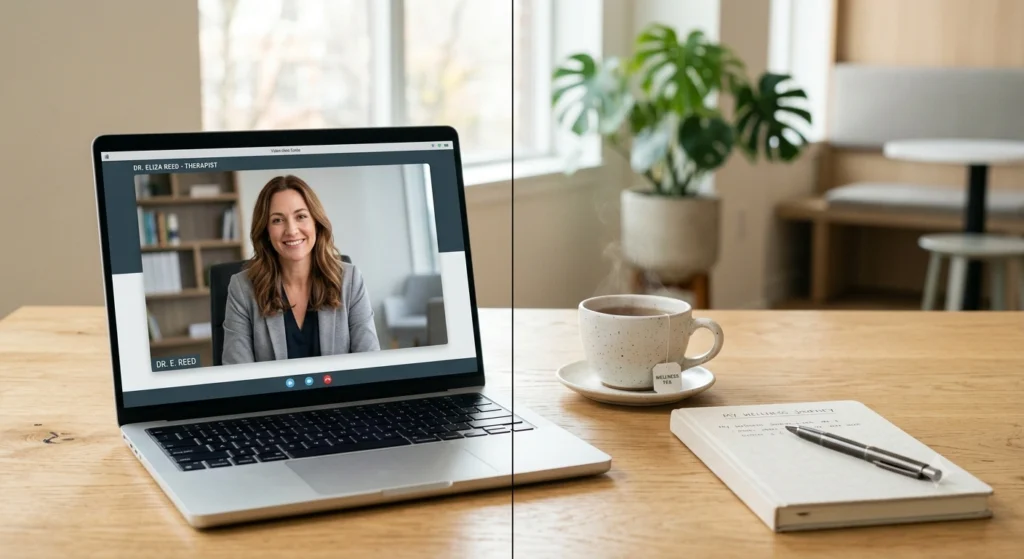
How does online therapy work in practice?
After you sign up. You as a rule complete a brief assessment that captures your main concerns and preferences. A matching algorithm or a human coordinator pairs you with a provider, and then you schedule a first session — regularly within a few days, which is why everything from messaging to billing stays inside a dedicated dashboard. “Answer a — no, scratch that, few questions” and choose psychiatry, therapy, or both. That simplicity is by design, not accident.
The process mirrors what you’d do in an in‑person clinic but cuts out the commute, the parking, and the awkward small talk with a front‑desk stranger. 7 Cups even offers 24/7 volunteer listeners for those moments. Hard to ignore those numbers. When you just need to vent to a human, though those listeners aren’t licensed therapists. The path isn’t always linear.
And a bunch of people mix formats depending on the day.
Why Online Mental Health Therapy Is Overtaking In‑Person Visits
As far as I know, it’s about speed, choice, and reducing the activation energy that stops. So loads of most of us from ever booking a first appointment. Long wait times, a thin pool of local specialists.
And the sheer mental load of arranging in‑person care have pushed online therapy from a niche option to a first‑choice solution. File that away.
You’ll see why it matters in a bit.
” No phone tag. Arguably for anyone who’s tried to work through the American healthcare system while already depleted, that efficiency is not a luxury; it’s a lifeline; and the numbers back it up.
Which brings up an interesting point. When PCMag reviewed online therapy services, they noted “three levels of plans” across major platforms. Highlighting how customizable the model has become. You can start small; messaging only — and grow.
“There are three levels of plans.” — PCMag review of Talkspace pricing
If you think about it, the shift also matches how we handle everything else now: banking, groceries, even dating. Mental health care was bound to follow. And for those in rural areas where the nearest psychiatrist is a two‑hour drive away, the difference isn’t convenience; it’s access that simply didn’t exist before.
Is online therapy really as effective as meeting face‑to‑face?
For most common conditions; anxiety, depression. Adjustment disorders, research shows basically equivalent outcomes. The therapists are the same. The modalities are the same, only the room is virtual.
The high-stakes factor is the therapeutic alliance, no, scratch that, that genuine connection between you and the clinician. It can absolutely form through a screen. Psychology Today’s directory lets you search for a therapist by specific issues.
And even by modalities like EMDR, meaning you can find an expert you’d not once physically meet otherwise. That’s not a compromise; that’s an upgrade in choice.
“Clients can help narrow down the search by condition or modality like EMDR.” — Psychology Today
That said — if you’re in active crisis — dealing with severe psychosis. Or need intensive in‑person monitoring, online therapy isn’t designed for that. The platforms themselves frame their care as outpatient‑style, not emergency response. So while the modality works, it works inside its lane — and knowing that lane is part of being a smart consumer.
The Genuine Upsides of Remote Support
Online mental health therapy: What does that mean in practice? The most tangible benefit is the removal of friction. You can talk to a therapist during a lunch break. From your parked car, or while your kids are napping.
On average, combine that with a variety of communication styles, and you’ve a system that adapts to your life instead of demanding (as one might expect) you adapt to it. However, nuance is required here.
Cost is the other substantial draw. In reality, without insurance — standard therapy can run $120–$250 per session.
Online platforms sometimes cut that by half. Or more, especially with messaging‑only plans. Talkspace’s $69‑per‑week tier gives you unlimited text access to a therapist, which.
For someone who just demands steady support without video, is a dramatically lower entry point. When insurance kicks in, the numbers look even better. Teladoc shows therapy visits from $0 to $99.
And psychiatry from $0 to $119, depending on the plan. That range is wide. But the possibility of free sessions is real. Of course, actual metrics may shift.
“Online therapy isn’t a lesser version of the real thing; it’s just therapy, minus the commute.”
You also get access to support formats that don’t really exist offline. Asynchronous messaging — Here’s a good proof, — lets you write out your thoughts in detail.
Then receive a thoughtful reply hours later. For some people.
That written back‑and‑forth produces deeper insights than a live 45‑minute session does., 7 Cups’ volunteer chat is there; not as therapy, but as a human voice when everything feels heavy.

What’s the downside that nobody discusses upfront?
Pricing models can be maddeningly opaque. A weekly subscription doesn’t guarantee a set number of live sessions, and some platforms let unused weeks roll on without refund. In reality, talkspace’s $69/week plan is messaging‑only; the $99/week plan adds video; the $109/week plan includes workshops.
But if you only need two video sessions a month, a per‑visit telehealth service might be cheaper. Comparing apples to apples demands spreadsheet‑level attention. And insurance coverage isn’t standard; you’ve to verify, and not all plans treat virtual care identically to in‑office visits.
Yet, context matters heavily.
⚠️ Warning
Read the cancellation policy carefully. Some subscriptions auto‑renew and you might pay for weeks you never use if you don’t proactively tell support you want to pause.
7 Cups’ listeners can be incredibly helpful for loneliness. Or day‑to‑day stress, but they can’t diagnose, treat, or manage medication. This holds true.
If you find yourself relying solely on that. You may be delaying the professional care you actually need. The distinction matters, especially when you’re already vulnerable.
Sorting Through Your Online Therapy Options
Before you even compare pricing. Clarify what kind of care you need. Do you want to talk through a concrete issue.
On average, services like Brightside combine psychiatry and therapy under one roof, which saves you from coordinating two separate providers. If you’re exploring talk therapy only.
A messaging‑focused platform like Talkspace could be economical. If insurance is your lifeline, Teladoc or Amwell become stronger candidates. Because their per‑visit costs drop sharply with coverage.
Here’s how three common types stack up:
| Platform | Typical Cost | Care Formats | Insurance | Best For |
|---|---|---|---|---|
| Talkspace | $69–$109/week | Messaging, video, workshops | Some plans accepted | Versatility across formats |
| Teladoc Health | $0–$119 per visit (with insurance) | Video, phone, psychiatry | Widely accepted | Maximizing insurance benefits |
| Brightside | Varies; includes psychiatry | Video, psychiatry, therapy | Some plans accepted | Those needing both therapy & medication |
In most cases, those variations mean you can match session length to your attention span. And budget, something fixed‑cost subscriptions don’t always allow.
✅ Action Steps
- Define your need — Write down whether you want talk therapy, medication, or both, so you don’t pay for extras you won’t use.
- Verify insurance — Call your insurer or use a platform’s benefits checker to see what’s actually covered before you commit.
- Compare per‑session costs — Calculate what a month of weekly sessions would cost on each platform, including subscription vs. pay‑per‑visit.
- Check therapist credentials — Use Psychology Today’s directory to verify that the platform employs licensed clinicians for your state.
- Read the cancellation terms — Understand how to pause or cancel so you aren’t charged for weeks you skip.
Does my health insurance actually cover virtual therapy?
Many plans now treat telehealth the same as in‑office visits, but you’ve to confirm. Teladoc reports that with insurance. Therapy visits can cost as little as $0.
Without coverage, you pay the full published rate. Don’t assume; call the number on the back of your card.
Can I just use a free chat service instead?
Free emotional support like 7 Cups’ volunteer listeners works for immediate relief. But it isn’t a substitute for licensed therapy.
If you need clinical assessment or a formal diagnosis. It’s a safety net, not the solution.
Keep this in mind; it shows up again soon.
People Also Ask
Is online therapy confidential?
You could say hIPAA‑compliant platforms encrypt your data, and therapists are bound by the same confidentiality (and that implies quite a bit) laws as in‑person practices. Always check a service’s privacy statement.
Can online therapists prescribe medication?
Consider this practical perspective. Only psychiatrists or psychiatric nurse practitioners can prescribe. Platforms like Brightside and Teladoc include that option. Usually as a separate add‑on or appointment type.
How fast can I get a first appointment?
7 Cups offers immediate volunteer chat for emotional support. Those numbers tell a story. Though clinical intake takes longer. Same‑week video sessions are common.
What should I look for in a therapist specifically?
Look for expertise in your area of concern. Psychology Today lets you filter by issues like anxiety, trauma, or substance use, and even by distinct therapy modalities like EMDR.
Is online therapy appropriate for teenagers?
Yes. Providing care for individuals 13 years. And older, brightside states it. Parental consent may be needed depending on state laws and platform policies.
FAQs
Are online therapy platforms required to be HIPAA compliant?
Yes, in the United States any service handling protected health information must follow HIPAA standards. Reputable platforms display their compliance prominently.
What if I don’t click with my matched therapist?
You can usually request a change. Many services, like BetterHelp. Allow unlimited switching until the therapeutic fit feels right.
How accurate are those online therapist directories?
Psychology Today’s directory is well‑regarded; providers are verified, and you can search by license, specialty, and insurance accepted.
Can I use online therapy for couples counseling?
Some platforms support multiple participants. But confirm with the service beforehand. Not all clinical licenses in every state permit online couples work.
Moving Forward With Confidence
Online mental health therapy has shed its early‑adopter stigma, so what remains is a practical, flexible way to get professional help without rearranging your life. The platforms aren’t flawless — pricing can feel like a maze, and the human element still depends on the individual clinician. But those are solvable problems if you approach the search with clear criteria.
It is transparent. In reality, start with a free assessment on a platform like Brightside or spend an hour combing through Psychology Today’s directory, the key is (more on that later) momentum, not perfection.
“The best time to start therapy was last year. The next best time is now — and you can do it from your couch.”
Across the board. What used to feel like a compromise now reads like common sense.
You wouldn’t drive 90 minutes to pay a bill in person. Why should your mental health be any different?
The screen doesn’t lessen the work. It just gets out of the way so you can finally begin.
🔍 Research Sources
Verified high-authority references used for this article