

Chatgpt go vs plus: Choosing between ChatGPT Go. Plus feels like second-guessing a menu with half the ctions missing. Both plans promise more than the free tier. Yet the gap between about $8.
About $20 per month hides technical tradeoffs most (and the data generally agrees) comparison guides skate right past. If you’ve found yourself staring at the upgrade screen, unsure whether the cheaper paid tier will disappoint you or whether the higher tier is overkill, you’re not alone. Industry analysts have noted that AI pricing tiers are becoming gradually fragmented. Making direct comparisons harder than they should be.
The stakes are real: pick wrong, and you’re either wasting about $12 a month on features you never touch or hitting frustrating usage caps right when you need the tool most. The confusion isn’t your fault. OpenAI has been rolling out new tiers.
Feature sets at a pace that even dedicated tech journalists struggle to track. The ChatGPT Go plan landed as a budget-conscious bridge between free access. The full power of Plus. What that bridge actually carries, and what it leaves behind, depends heavily on how you work.
Some users describe Go as the sweet spot for daily casual work. Others say it feels restrictive the moment you push beyond lightweight tasks. A closer look at model access, usage limits, ad experience, and regional availability reveals a clearer picture than any single spec sheet can convey. Once you understand those four dimensions, the right choice becomes far less ambiguous.
ChatGPT Go vs Plus:
- ChatGPT Go sits around $8 per month while Plus costs about $20; that $12 gap buys you access to tools like Deep Research, Agent Mode, and Sora.
- Go users get roughly 10x higher message limits than free tier users, according to OpenAI’s own framing, but still far less headroom than Plus.
- Recent reports confirm that both Free and Go tiers now include advertisements for adult users in the United States; Plus remains ad-free across the board.
- Regional availability for Go is patchier than Plus. If you’re outside a supported region, Go simply won’t appear as an option, which makes the decision for you before you even compare features.
- Model access is the biggest hidden differentiator. Go primarily runs on GPT-5.2 Instant for quick replies according to ClickRank analysis, while Plus opens up GPT-5.4 Thinking and reasoning models that handle multi-step analysis far better.
What Exactly Is ChatGPT Go vs Plus?
From what we can tell, and ChatGPT Plus reflects two rungs on OpenAI’s paid access ladder. Hang on – there’s more.
Go launched as a lightweight paid tier targeting those using it who wanted more than the free go through but didn’t need the full power-user toolkit. Plus, which has been around longer, remains the flagship individual subscription aimed at professionals. Researchers, and anyone whose workflow demands deeper reasoning and higher usage ceilings.
Go gives you elevated limits across messages, image generation, file uploads, and memory retention next to the free plan.
OpenAI itself described Go as delivering “10x higher message limits, 10x more image generations, 10x more file uploads, and 2x longer memory compared with our free tier,” according to an AIFreeAPI summary of the company’s claims. Those numbers sound generous at first glance. But context matters: the free tier’s caps are tight enough that a casual user can hit them in a single afternoon of heavy prompting. So “10x” starts from a low baseline.
Plus, by contrast, was built from day one (depending entirely on the context) as the no-compromise individual plan. FastGPTPlus describes it as providing “unlimited messaging; legacy model access (GPT-4o), Sora video generation, deep research agents. ” Specifically “unlimited” appears in multiple third-party breakdowns, though actually fair-use throttling still applies under extreme load. See for yourself.
Still, the headroom difference is stark. If you’ve ever been mid-project and gotten — correction, that dreaded “you’ve reached your limit” message. The distinction stops being academic snappy.
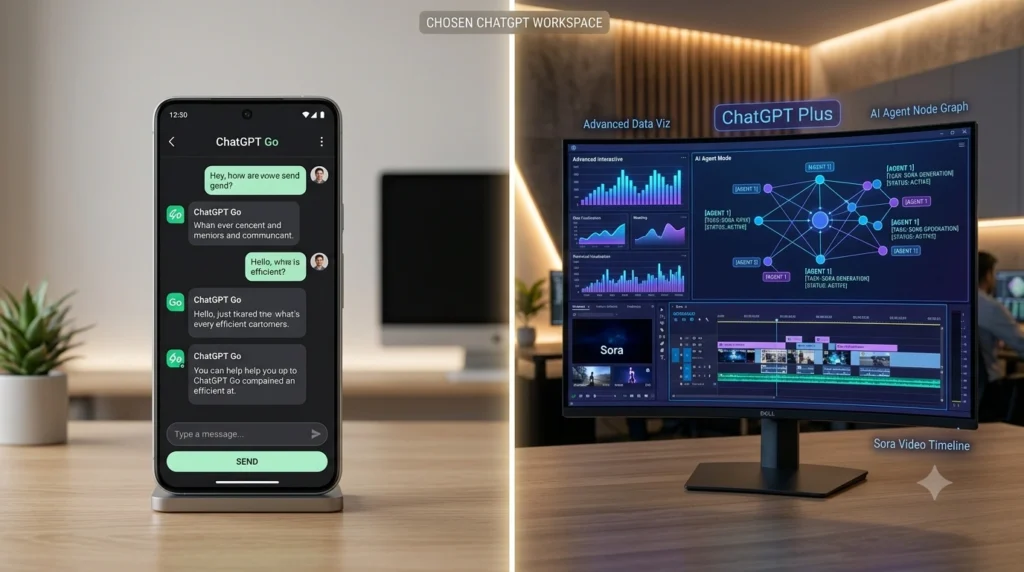
Where the two plans diverge most sharply is on advanced tooling, deep Research, Agent Mode, and Sora video generation consistently appear in Plus feature lists across multiple comparison sources and remain entirely absent from Go. These aren’t marginal add-ons.
Deep Research can autonomously pull together multi-source reports that would take a human hours. Agent Mode lets the model execute multi-step tasks without hand-holding. Sora generates video from text prompts. For someone who never touches any of those, the absence means nothing.
For someone whose workflow depends on even one of them. Go becomes a non-starter instantly.
Feature Comparison: Where the Real Differences Live
Tables make comparison cleaner than paragraphs ever can. Here’s how the two plans stack up across the dimensions that actually affect daily use.
| Capability | ChatGPT Go | ChatGPT Plus |
|---|---|---|
| Monthly price | About $8 | About $20 |
| Primary model | GPT-5.2 Instant (fast replies) | GPT-5.4 Thinking, plus legacy GPT-4o access |
| Deep Research | Not available | Available |
| Agent Mode | Not available | Available |
| Sora video generation | Not available | Available |
| Ad experience (U.S.) | Ads present for adult users | Ad-free |
| Regional availability | Fewer regions | Broadly available globally |
| Message limits vs free | Roughly 10x higher | Far higher, described as near-unlimited |
| Image generation | Higher caps than free, lower than Plus | Significantly higher caps |
| File uploads | Increased limits over free | Maximum headroom |
| Memory retention | 2x longer than free | Longest retention window |
chatgpt go vs plus:
Noticed the pattern? Go is basically an amplified free run into. You get more of everything the free plan offers. But hit the ceiling earlier than Plus those using it do.
Plus opens up completely new capability categories that Go doesn’t touch, the price difference, spread across a year, works (and the data generally agrees) out to roughly $144. That’s not a small shift. Yet, whether that $144 buys you meaningful value depends fully on whether you’ll use Deep Research.
Agent Mode, or Sora even once a month. Yet, context matters heavily.
From what we can tell, the $144 annual gap isn’t just about features you might use. It’s also about friction reduction.
If you hit Go’s usage caps twice a week and have to stop working or switch to a less capable tool, the productivity cost over 12 months likely dwarfs the subscription difference. Kind of surprising, right?
Time lost to arbitrary limits is the hidden line item nobody budgets for.
Pricing and Limits: The Math Behind Both Plans
On paper, the $8 versus $20 comparison looks simple. Go costs less than half of Plus. But raw price comparisons miss how usage patterns interact with plan limits, and, okay, more accurately, that interaction is where the real (though exceptions exist, naturally) cost difference hides. Hold onto this thought.
A user who prompts ChatGPT 15 times a day across light tasks will almost never hit Go’s boundaries.
Someone running multi-hour research sessions with long context windows, repeated file uploads, and image generation will hit them by Tuesday. The Times of India noted the Indian pricing at Rs 1,999 for Plus, contextualizing the gap for regional audiences, but the structural actives remain identical regardless of currency: heavier users subsidize lighter users on the Go tier by hitting caps and either stopping or upgrading.
Looks at the ad factor. On February 9; 2026, OpenAI officially began testing advertisements in the United States for adult everyone on both the Free. And ChatGPT Go plans, according to GLBGPT. Plus users see none of this.
You could say for others, they break focus during work that demands sustained concentration. The value of an ad-free environment is subjective but real, which is why if you spend 90 minutes a day in the interface, that’s 90 minutes of uninterrupted attention versus 90 minutes with periodic commercial interruptions.
That changes the picture quite a bit. Over a year, the cognitive cost compounds.
Then there’s the regional dimension. Multiple sources confirm that Go is available in fewer countries than Plus. This isn’t a minor footnote. If you travel often or live in a region where Go hasn’t launched, the cheaper plan simply doesn’t exist for you.
Not always the case. The decision gets made by geography before you ever compare features.
For globally distributed teams or remote workers who move between countries. Plus offers consistency that Go structurally can’t match yet.
Common Mistakes When Choosing Between Go and Plus
” That’s the wrong first question. Keep that in mind. The right one is “what’ll I actually do with this subscription. ” Confusing price with value leads to predictable mistakes that show up repeatedly in user discussions across forums and comparison guides.
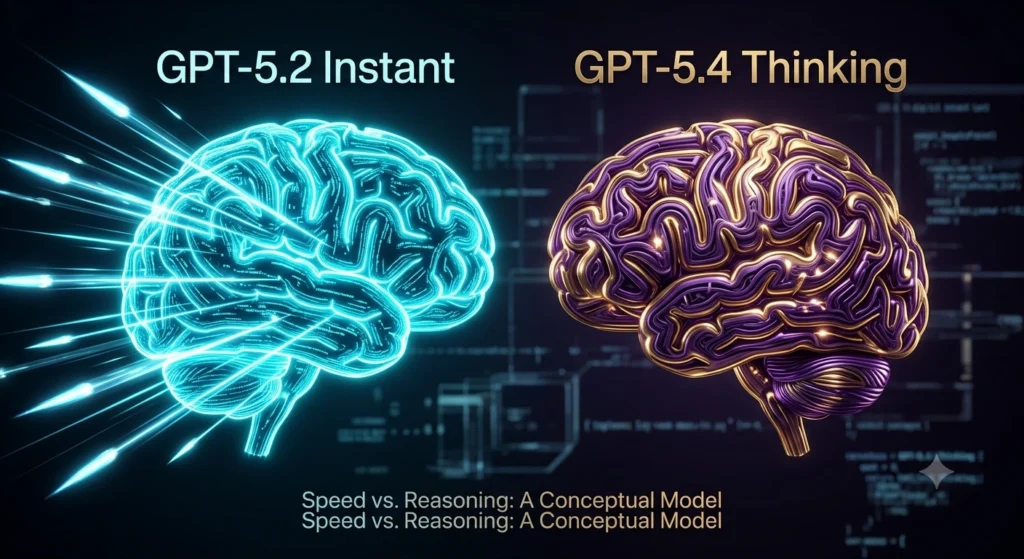
Mistake one: underestimating usage frequency.Someone signs up for Go thinking they’ll use it a few times a week. Within two weeks, they’ve integrated it into their daily workflow, discovered new use cases, and suddenly the caps feel suffocating. Upgrading later means they paid $8 for a month of frustration before paying $20 anyway. If you’re even moderately curious about AI workflows, assume your usage will grow, not stay flat.Mistake two: ignoring the ad variable.Free and Go users in the U. S. Now see advertisements during sessions. Many people don’t realize this until they’ve already subscribed. If you work in a professional setting where focus matters, an ad-supported AI tool can feel jarring. It’s not about snobbery. It’s about task-switching costs. Every ad break is a micro-interruption that fragments your train of thought.Mistake three: fixating on model names instead of capabilities.The distinction between GPT-5.2 Instant and GPT-5.4 Thinking isn’t just marketing terminology. The Instant variant improves for speed on straightforward queries. The Thinking models handle multi-step reasoning, contradictory information, and detailed analysis with demonstrably better accuracy. If your work involves anything beyond simple Q&A, the model gap shows up in output quality, not just response time.Mistake four: assuming Go is “Plus Lite.” It’s not. Go is “Free Plus.” It amplifies the free experience. Plus is a different product category. Confusing the two leads to disappointment when users discover Sora, Deep Research, and Agent Mode aren’t behind a settings toggle, they’re behind a paywall Go doesn’t cross.
What happens next? A slightly contrarian take here: for a small but real segment of users.
Go is the smarter financial decision even if they occasionally want Plus features. Someone who asks for Deep Research twice a year can subscribe to (more on that later) Plus for one month. So where does that leave us? Do their research, then drop back to Go.
The key here is that the annual cost: about $8 ×, to be more precise, 11 + $20 × 1 = $108, versus $240 for full-year Plus. Make of that what you will. That’s a $132 savings with genuinely little sacrifice.
OpenAI doesn’t penalize plan switching. Most comparison guides don’t mention this tactic, but it works.
FAQs
Which plan is better for everyday casual use, Go or Plus?
For light daily tasks like drafting emails, summarizing short documents, — thinking about it more, or answering blazing questions, ChatGPT Go handles the workload comfortably. The elevated message. And image limits over the free tier mean — actually, that’s not quite right, most casual users won’t run into caps during normal use.
If you never touch Deep Research, Agent Mode, or Sora, the $8 monthly price delivers genuine value. That changes the picture quite a bit. But wait, there’s more to it. The tipping point comes when casual use gradually becomes heavy use.
Which happens more a lot than people expect once they connect the tool into their routine. But this is just one piece of the puzzle.
Does ChatGPT Go include advertisements?
Yes, based on recent reporting. OpenAI began testing advertisements for adult users on Free. And Go plans in the United States starting February 9, 2026.
ChatGPT Plus remains ad-free., the ad experience may differ, but the structural (depending entirely on the context) distinction is clear. Go users in the American market should expect commercial interruptions during sessions, and Plus anyone on the platform shouldn’t.
Can I access Sora video generation or Deep Research with ChatGPT Go?
You’ll see how this ties into the previous point, no. Both Sora and Deep Research are consistently cited across multiple comparison sources as Plus-exclusive features. Which brings up an interesting point. Go doesn’t include access to either tool.
If video generation or autonomous multi-source research matters to your workflow, Go won’t meet that need, regardless of how constantly or how little you’d use those features.
Is ChatGPT Plus worth the extra cost over Go?
Realistically, it depends almost entirely on two factors: how constantly you use the service and whether you need the advanced resources. Consider this: a power user who runs long sessions, uploads large files, generates images regularly. Nine times out of ten, the decision isn’t universally one-sided; it’s a function of individual workflow. You could say and then decide, is the most pragmatic path for most of us still unsure.
Is ChatGPT Go available everywhere that Plus is?
No. Multiple industry sources confirm that Go is currently available in fewer regions than Plus. If you’re in a supported region, Go appears as (and rightly so) an option during sign-up. If you’re not.
Plus offers broader global availability, which matters for remote workers, frequent travelers, and anyone living in a market where (which aligns with standard practices) Go hasn’t launched yet.
Conclusion
The ChatGPT Go vs Plus decision Basically, pivots on a single question that most comparison guides bury under spec sheets. Hang on – there’s more. How much do you actually use this tool, and for what? Answer that honestly, and the plan choice follows almost automatically.
Keep this in mind; it shows up again soon.
This brings up an interesting angle. If you’re a light daily user who wants more than free offers without spending $20 monthly, Go delivers. You’ll get higher message limits, more image generations, longer memory. And the core ChatGPT experience at a price that’s painless to justify.
Market. No advanced apps, and tighter caps than Plus. But for the right usage pattern, those tradeoffs don’t matter.
If you regularly push the tool to its limits, need reasoning models for complex (at least based on current observations) work, or use Deep Research. Agent Mode, or Sora even occasionally, Plus is the only paid tier that actually supports your workflow. The $20 monthly price looks less like an expense and more like a productivity investment once you factor in the time saved by avoiding caps and accessing higher-quality model outputs.
One final thought worth considering. The plan you choose today doesn’t lock you in permanently. Experimentation costs seriously little. Try Go for a month.
If the caps frustrate you, upgrade. If you’re on Plus and realize you rarely ever touch the advanced features, downgrade. The subscription model here is forgiving, and the best way to resolve the comparison debate is to experience the constraints firsthand rather than reading about them in an article like this one.