

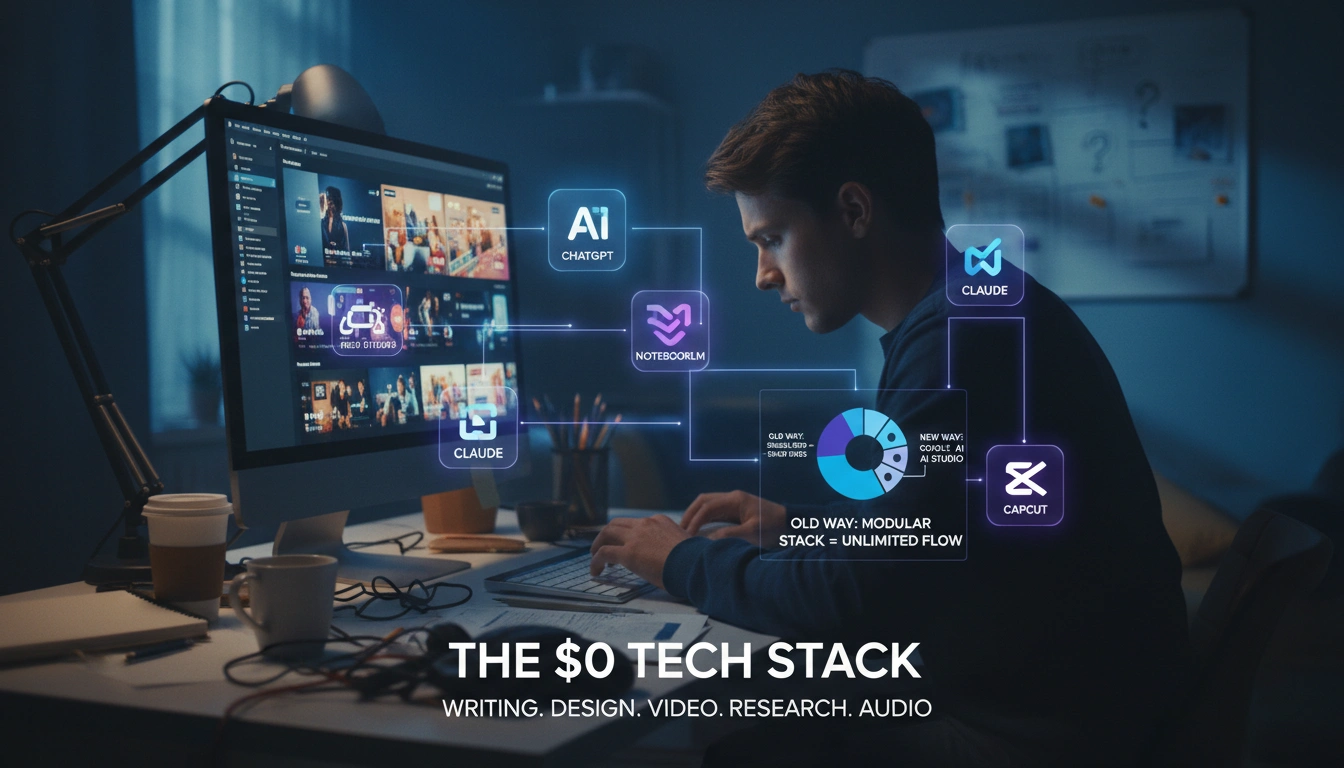
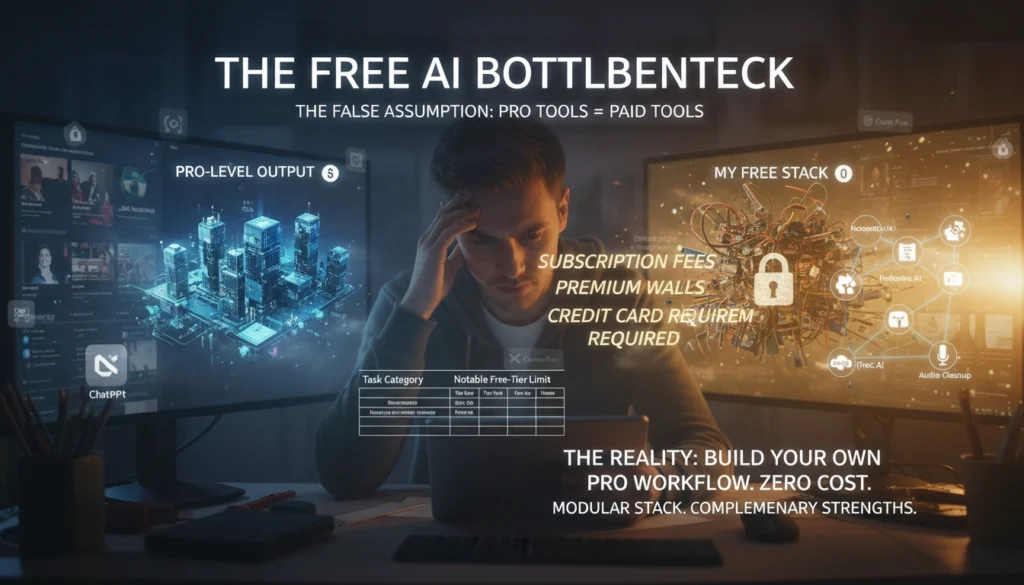
The exact kind of frustration every budget-conscious creator knows: you watch another polished explainer video. Scroll past a flawless social carousel; or read a crisp, research-backed newsletter. You think. How much did they pay for the apps behind that?
Probably a lot. The contrast is clear. That assumption is where the real bottleneck starts. It convinces you that genuine.
Pro-level output demands a monthly tech bill you can’t afford right now. You either downgrade your standards or stall out altogether.
The reality, hidden in plain sight, is far more interesting. Free AI apps have reached a tipping point where they can drive a complete creative workflow. From first rough idea to export-ready asset, without a single invoice. The real challenge isn’t finding them.
It’s arranging them into something that doesn’t fracture your focus or (at least based on current observations) waste your morning.
Key Point
- Free AI tools now cover the entire production chain — writing, design, video, research, and audio cleanup — so you can build a fully functional stack at zero cost.
- The biggest mistake creators make is betting everything on a single tool instead of combining complementary strengths, which leads to hitting rate limits mid-project and abandoning the workflow entirely.
- Industry guides and creator roundups consistently show that understanding weekly caps, watermarks, and model fallback behavior before you start is the single most effective way to avoid project-killing surprises.
- Anecdotal evidence from creator forums suggests that roughly 7 out of 10 professionals now test concepts and build early portfolios using only free tiers, upgrading only when a client or revenue stream directly funds the purchase.
What Are Free AI Tools? (And What They Aren’t)
Free AI apps are software platforms or APIs that let you access AI-powered capabilities
Some are entirely free with no credit card required, like Google AI Studio. Stick with me here. Others operate on a freemium model where the free tier gives you a capped face. Before nudging you toward a paid plan. The distinction matters. Because calling something “free” without checking those caps can blow up a deadline.
Wait, that definition asks for a little more texture. Actually, let me put that more precisely: a lot of tools in this bucket aren’t scaled-down toys.
Google AI Studio, Here’s one, offers full access to Gemini models for testing. Building, with lower rate limits that still support real experimentation. It’s completely free in all available countries.
Compare that to a one-week trial that slams the door on day eight. Completely different category.
The industry has trained a bunch of professionals to believe zero cost equals zero reliability. That’s just not true anymore. 5, with a 5-hour usage cycle). In reality, or limited flagship model access on ChatGPT before it drops back to a lighter model when you’ve burned through your quota. These are real workhorses, not gimmicks.

When we talk about free AI tools, we mean platforms where the no-pay entry is stable, the limits are transparent, and the output is production-grade enough that you can ship actual work. Not everything qualifies, but far more qualifies than most creators assume.
Why Free AI Tools Matter Now More Than Ever
The economic pressure on independent creators, freelancers. And small marketing teams hasn’t let up. Software subscriptions have a nasty habit of multiplying silently, and you start with one design app, then you need a text expander, then a research assistant, then a video transcriber.
Look at the research patterns. DataCamp’s 2026 roundup notes that platforms like NotebookLM now function as heavy-duty research assistants, grounding analysis in your own uploaded documents rather than hallucinating from thin air. That changes the picture quite a bit. You might be wondering; why?
And Machined’s 2026 analysis points out that both Claude and ChatGPT free tiers have quietly; well, actually, rolled out access to powerful reasoning models that a year ago were locked behind paywalls. Kind of surprising, right? The key here is that the gap between free and paid is shrinking blazing.
There’s a psychological win here too. When you don’t have to swipe a card, you’re more likely to experiment. That’s where the real skill-building happens. You try a dozen thumbnail variations in Canva’s free AI design tools, or you generate five different headline approaches in a chatbot.
And you learn what works without that; you know what, tick of anxiety about “wasting” a paid quota. Many creators report that this low-stakes testing cycle is what finally got them past creative blocks; the free tier, in that sense, isn’t a discount; it’s a training ground.
Of course, actual metrics may shift.
“If it’s free. ” That misconception comes from an older era (which works out well in practice) of software demos. As it turns out, today’s leading free AI models are all the time the same architecture as the paid ones, just gated by usage frequency or concurrent capacity.
You might get GPT-4o mini after your flagship allocation runs out. But for 80% of drafting tasks, the quality difference is nearly imperceptible. The data speaks for itself.
The key here is that recognizing that’s the difference between someone who keeps paying out of habit and someone who builds a really lean operation.
Curating Your Free AI Toolkit: One Tool for Each Critical Task
You’ll see how this ties into the previous point, a single AI tool can’t do everything well. Not even the paid ones. The consensus from guides across Google Cloud’s developer what you have, Machined, and DataCamp is that the strongest free AI stack is built from modules; one reliable tool per production category.
It clicks once you see it in action. Here’s how that breaks down in practice, not theory. At least, that outlines the core theory.
Writing and Idea Generation.The free tier of ChatGPT and Claude are your anchors. ChatGPT gives you initial access to a flagship model before falling back to a lighter version, while Claude offers a rolling 5-hour window on Sonnet 4.5. That rhythms cycle matters. If you plan drafting sessions around the reset window, you can sustain a full writing workflow without ever bumping into a hard wall. For quick rewrites, grammar checks, and blog outlines, both are more than enough.Research and Fact-Checking.NotebookLM shines when you need document-grounded analysis. Upload your research papers, transcripts, or competitor briefs, and it synthesizes answers strictly from your provided material. Perplexity AI, flip side, pulls live search data and cites sources directly, which makes it exceptional for fact-verification before you hit publish. Neither costs a cent to start, and combining them eliminates the biggest risk in free AI writing: made-up statistics.Visual Design and Brand Assets.Canva’s free AI tools get you to thumbnails, social posts, and simple brand kits remarkably fast. No credit card needed. It won’t produce print-ready, multi-layer packaging files, but for online content, it’s a workhorse. The catch, and it’s one worth bookmarking, is that some exports will carry a Canva watermark if you’re using premium elements inadvertently. Always preview the final download before committing.Video Editing and Short-Form Clips.CapCut is the most frequently cited free video editor in recent creator roundups. It handles trimming, auto-captions, background removal, and basic motion effects. But here’s the real talk: many free video and image tools still slap watermarks on exports or cap resolution at 1080p. That’s fine for Instagram Reels. It’s not fine for a client deliverable. CapCut’s free tier is solid enough to build a portfolio of shorts, but you’ll want to test your export settings early in the process, not five minutes before a deadline.Audio Cleanup and Transcription.
This category is a bit more fragmented. Several community-recommended free solutions exist for voice isolation, background noise reduction, and automated subtitling. Many creators pair a free transcription tool with CapCut’s built-in captioning to produce clear, accessible video without touching a paid service. The key is to keep your audio chain lightweight; chasing too many free audio plugins will bog you down.
(And yes, you can add Google’s Antigravity for coding assistance during public preview. Offering unlimited tab completions and command requests under weekly rate limits. ). If you’re a developer creator building tool demos.
Below is a snapshot of how these solutions map (more on that later) to your daily tasks:
| Task Category | Top Free AI Tool | Notable Free-Tier Limit |
|---|---|---|
| Writing & Drafting | ChatGPT (free) / Claude (free) | ChatGPT drops to GPT-4o mini after cap; Claude cycles every 5 hours |
| Research | NotebookLM / Perplexity AI | NotebookLM: document-specific; Perplexity: live search, source-linked |
| Design | Canva (free AI features) | Some premium elements trigger watermark |
| Video | CapCut | Watermark on some exports; resolution restrictions may apply |
| API Experimentation | Google AI Studio | Completely free with lower rate limits for testing |
Switching focus for a Also worth noting, in most scenarios, keep this in your back pocket. None of these platforms demands a credit card to start, which means you can try the entire stack this afternoon. The real failure point isn’t the tools themselves but the assumption that you need to master all of them at once.
Common Pitfalls That Derail Your Free AI Workflow
I’ve watched talented creators scrap entire projects. What this means is because they didn’t read the fine print on a free tier. They aren’t. Which brings up an interesting point.
They’re generous, but they’ve walls.
Consider rate limits. Claude’s free tier resets every five hours, so if you’re drafting a 3,000-word script in one sitting, (and rightly so) you’ll hit the ceiling hard. That’s not a small shift. The address is simple: batch your heavy drafting into the start of a cycle, then use the downtime for editing or design.
That’s not a technical hack; it’s workflow design. Yet the majority ignore the cycle and then blame the tool.
Another quiet killer: the fallacy of the all-in-one platform. No absolute guarantees.
Creators often chase a single free tool that does everything, and when it doesn’t, they conclude free AI is useless. But the real power sits in a modular stack.
Switch between ChatGPT for structure — NotebookLM for verification — and Canva for visuals. Context matters here. Yes, that’s three browser tabs.
But switching between best-in-breed free resources costs far less time — I mean, than force-fitting one tool to a task it wasn’t built for. The ones who thrive here are those who adopt the switch as part of the creative rhythm, not a disruption.
Then there’s the watermark problem. CapCut and certain Canva elements will stamp your work. Unless you pay attention at export. In the end, if your project is for a polished client pitch.
That watermark will make you look amateurish. Solution: test your export immediately. Looking closer, after creating the first draft, not after final polish. One 30-second preview saves a whole lot of rework.
Of course, actual metrics may shift.
Consider this practical perspective. But here’s the thing – obviously, here’s a more subtle risk. Thinking that free AI tools are static. Google’s free offerings, like, shift from public preview to for the most part available, and rate limits change.
If you built a workflow around a specific model version and almost never revisited the terms. You might wake up one morning to a “quota exceeded” message right before a launch.
Checking limits once a month takes five minutes and prevents the kind of panic that forces you to fall back to inferior manual work.
Your Top Questions About Free AI Tools, Answered
Can you really replace paid software with free AI tools?
If you’re producing content for online channels, blogs, social, newsletters. Explainer videos — the answer leans heavily toward yes for (which aligns with standard practices) about 80% of tasks. Drafting, research, basic editing, and hassle-free graphics all map to free tiers without a noticeable dip in quality. Where you might still want a paid tool is in final mastering.
High-bitrate video exports, or multi-format branding that calls for pixel-perfect consistency. But for the early-to-mid stages of content production, free tools handle the heavy lifting.
How do free AI platforms make money if I’m not paying?
Most operate on a freemium model. The free tier draws you into the setup, shows value, and builds loyalty. Once you need deeper usage, team features, or top-tier model access, you upgrade. Some, like Google AI Studio, offer the free tier to fuel API adoption, which eventually (depending entirely on the context) feeds into their cloud services.
Hang on – there’s more. The real question is, does it work?
Your free usage is, in a sense. A long-term investment in the platform’s growth. That doesn’t cheapen the tool; it aligns incentives.
What’s the best free AI tool for long-form article writing?
Taking a step back here, from what you’ll see, at a high level, it depends on your rhythm. If you draft in bursts.
If you need consistent, ongoing help throughout the day, ChatGPT’s free tier (with fallback to GPT-4o mini) gives more sustained access. Pair either with NotebookLM to fact-check claims and you’ll avoid the notorious hallucination drift that plagues pure chatbot drafting. Which at its core drives the core point.
Do all free video AI tools leave watermarks?
Not all, but plenty of do. CapCut, like, applies watermarks on certain exports when using premium effects or templates. Other free video editors like DaVinci Resolve (which includes some AI features) don’t watermark. But they’ve steeper learning curves.
The smart approach is to check export settings before starting the actual edit. If a watermark appears, switch to a simpler edit or use the tool only for internal drafts, not client-facing finales.
Yet, context matters heavily.
How many free AI tools should I use at once?
Start with three: one for writing, one for research. And one for design, which is why trying to juggle ten different free tools will fracture your attention and erase the time savings you’re supposed to gain.
Once those three are ingrained in your daily flow. You can add a video or audio tool. The creators who report the smoothest deal with almost almost never have more than five tools in their active rotation.
Ready to Build Your Free AI Stack?
The barrier to professional-grade creative work has never been lower. And the tools that prove it don’t ask for a credit card. The shift that actually matters is moving from passively collecting free tool names to actively arranging them into a workflow that respects their limits and plays to their strengths.
Take 20 minutes today to test Google AI Studio’s completely free API access. Not exactly what you’d expect. Or start a draft on Claude’s free tier and time your session.
Which means doing that’ll teach you more about real-world capability than any roundup can. The ones who succeed with free AI workarounds aren’t the ones who read the most lists. They’re the ones who tested, adjusted, and shipped.